Flotten-Telematik: OBD-II LTE, Anhanger BLE
June 4, 2026 · 7 min read · Case Studies
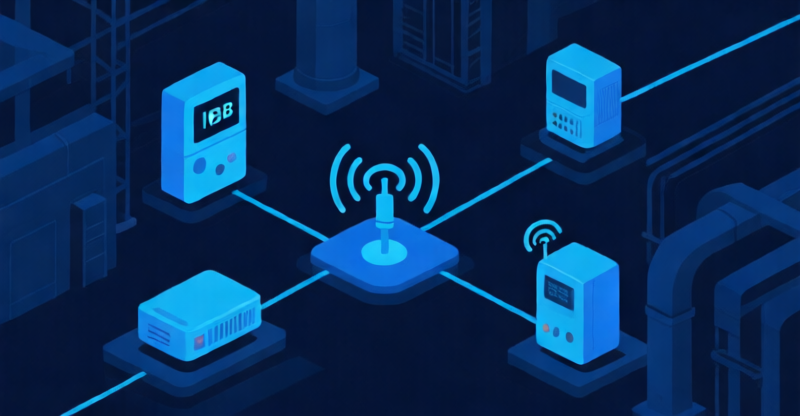
GPS 30s, OBD-II 1min. Multi-IMSI <5s an Grenzen.
A modern fleet telematics deployment has three data streams running simultaneously: GPS at 30-second intervals, OBD-II engine diagnostics at 1-minute intervals, and trailer sensor data (temperature, door open/close) at 5-minute intervals. At a border crossing, all three streams go silent for 60-90 seconds while a single-IMSI SIM re-registers on the foreign network. In that window, the truck has moved 1-2 km. The GPS track has a gap. The cold-chain log has a missing interval. The engine data has a hole. Multiply by 500 trucks crossing 4 borders daily and the compliance and operational impact is not theoretical.
The Three Data Streams and What They Need From the SIM
| Stream | Source | Interval | Data Volume | Latency Tolerance | SIM Requirement |
|---|---|---|---|---|---|
| -------- | -------- | ---------- | ------------- | ----------------- | ---------------- |
| GPS position | GNSS receiver | 30 sec | ~50 bytes/transmission | Medium (30-60 sec acceptable) | Always-on PDP, fast re-attach |
| OBD-II / CAN | J1939/J1708 bus | 1 min | 200-500 bytes/transmission | Low (engine faults need near-real-time) | Reliable uplink, no NAT timeout |
| Trailer sensors | BLE-to-gateway or direct cellular | 5 min | 100-300 bytes/transmission | Medium (5-15 min acceptable) | Data pooling across fleet |
The SIM must support all three simultaneously, across borders, without session loss. A standard consumer SIM with 60-second NAT timeout will drop the OBD-II stream at every cell handover. An IoT SIM with always-on APN and multi-IMSI keeps all three alive.
OBD-II and CAN Bus: What the Telematics Device Actually Reads
The OBD-II port (SAE J1962 connector, mandatory on all vehicles sold in the US since 1996 and EU since 2001) exposes the CAN bus (Controller Area Network). A plug-and-play telematics device clips into the port and reads: engine RPM, vehicle speed, fuel level, coolant temperature, throttle position, diagnostic trouble codes (DTCs), and MIL (check engine light) status. Heavy-duty vehicles use SAE J1939 over CAN for additional parameters: axle weight, brake wear, DEF fluid level, PTO engagement.
The telematics device is an embedded Linux or RTOS system with: GNSS receiver (GPS + GLONASS + Galileo for multi-constellation accuracy), cellular modem (LTE Cat-1, Cat-M1, or Cat-4), BLE/WiFi for trailer sensor bridging, accelerometer for harsh-event detection, and optional CAN transceiver for direct bus reading.
Source: Topflytech, "TorchX Series OBD2 Plug & Play LTE Fleet GPS Tracking Solution", 2025. Available at https://www.topflytech.com/en/application-obd2-plug-n-play-vehicle-tracking-solution/
The SIM Architecture That Survives Borders
A single-IMSI roaming SIM crossing from Germany to Poland to Ukraine experiences 60-90 seconds of downtime at each border while the modem re-registers. A multi-IMSI eSIM with Deutsche Telekom, Orange Polska, and Kyivstar profiles switches at the SIM layer in under 5 seconds — the modem detects a new network, the SIM selects the local IMSI, and the PDP context re-establishes. The data streams continue.
The architecture has three layers: the eUICC (multi-IMSI profiles, SIM-level switching), the modem (LTE Cat-1 or Cat-4, dual-antenna MIMO for highway coverage), and the CMP cloud (fleet-wide visibility per device, per country, per carrier). The SIM is the only component that touches all three.
For fleets operating in markets with permanent roaming restrictions (Brazil, Turkey, Nigeria, India), the multi-IMSI SIM must also include a local IMSI for each restricted market. The SIM detects the restricted market's network, activates the local profile, and the device appears as a native subscriber. This is the same architecture used for stationary deployments but the switching must happen at highway speeds.
Source: IoT Now, "How to solve connectivity for next-gen fleet telematics", March 2025. Available at https://iot-now.com/2025/03/12/150264-how-to-solve-connectivity-for-next-gen-fleet-telematics/
Source: Telenor IoT, "Toyota Material Handling: Enhancing Global Fleet Management with Local Connectivity", 2025. Available at https://iot.telenor.com/iot-case/toyota-material-handling-enhancing-global-fleet-management-with-local-connectivity/
The Trailer Problem: BLE Bridging vs Direct Cellular
Trailers are unpowered, detached from the tractor regularly, and often operated by different companies than the tractor. Three architectures exist: BLE sensor on trailer → BLE-to-cellular gateway in tractor cab (cheapest, but data stops when trailer is detached), direct cellular on trailer with battery-powered NB-IoT or LTE-M modem (most reliable, higher per-trailer cost), and RFID/license plate recognition at depots with no real-time tracking (cheapest, no in-transit visibility).
For cold-chain compliance, direct cellular on the trailer is the only architecture that maintains continuous temperature records during trailer drop-off periods. The trailer SIM is a separate procurement from the tractor SIM — it needs multi-year battery, IP67 enclosure, and data pooling across the fleet so a few high-usage trailers do not blow the shared data cap.