Wie Multi-IMSI-SIMs Entscheiden, Welches Netz Sie Nutzen — Die Steering-Logik im 6mm-Chip
· 7 min read · Technical Whitepapers
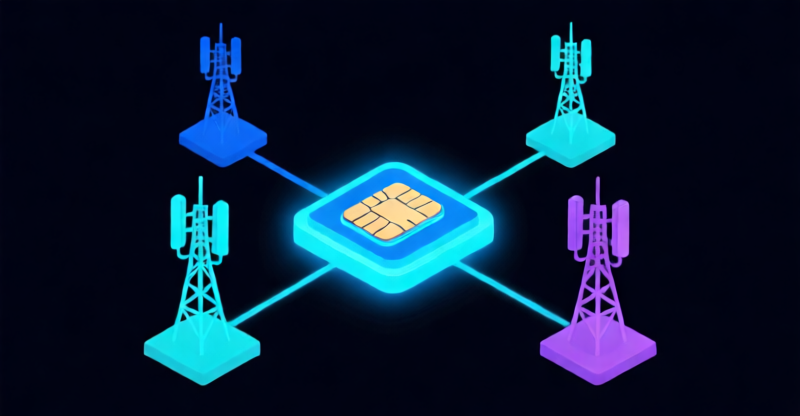
Eine Multi-IMSI-SIM tragt 3-10 Teilnehmeridentitaten auf einem einzigen Chip. Ein Java-Card-Applet liest die LOCI-Datei, pruft die aktuelle IMSI gegen sichtbare Netze und — wenn das Netz ablehnt — wechselt zur nachsten IMSI, loscht die gesperrte PLMN-Liste und versucht es erneut.
Ein Gerat mit Multi-IMSI-SIM startet in Rotterdam. Seine aktuelle IMSI ist ein Vodafone-Niederlande-Profil. Das Modem scannt sichtbare PLMNs und verbindet sich in unter 2 Sekunden. Dasselbe Gerat startet zwei Stunden spater in Istanbul. Die Vodafone-NL-IMSI ist jetzt Roaming-Besucher. Turkcell lehnt ab. Das SIM-Applet erkennt die Ablehnung uber den LOCI-Status, wechselt zur nachsten IMSI (Turk-Telekom-Lokalprofil), sendet REFRESH ans Modem, loscht die FPLMN-Liste und verbindet neu. Gesamtzeit: ~45 Sekunden.
Das Steering-Applet: LOCI-Polling und REFRESH-Zyklus
Die Intelligenz liegt in einem SIM-Toolkit-Applet — einer Java-Card-Anwendung auf der UICC. Alle 20-30 Sekunden sendet das Mobilfunkmodul eine STATUS-Nachricht an die SIM. Jede 4. STATUS-Nachricht sendet das Applet einen PLI-Befehl. Das Modul antwortet mit der LOCI-Datei. Enthalten: MCC, MNC, Gebietscode und der Location Update Status. Bei Nicht-UPDATED-Status nach 2-3 Minuten lost das Applet die IMSI-Rotation aus.
Round-Robin vs. Network-Steered
Round-Robin: Das Applet fuhrt eine geordnete IMSI-Liste (3-10, werksseitig geladen). Aktuelle IMSI fallt aus → nachste IMSI. Einfach, keine Backend-Infrastruktur. Network-Steered: Gleicher Mechanismus, aber mit zentral optimierter Reihenfolge durch das CMP basierend auf Grosshandelspreisen und SLA pro Land.
Multi-IMSI + eUICC: Die 2025-Architektur
eUICC-SIM wird mit einem Multi-IMSI-Profil als Primarprofil geladen. Das Multi-IMSI-Applet ubernimmt tagliche schnelle Wechsel (90% der Operationen, unter 1 Minute). Die eUICC-Schicht ermoglicht OTA-Download neuer Profile fur Lander ohne geladene IMSI (restliche 10%).
Häufig gestellte Fragen
How fast does a multi-IMSI SIM switch networks?
First IMSI attempt: under 2 seconds if accepted. IMSI switch after rejection: 40 seconds to 5 minutes (the applet polls LOCI every 20-30 seconds, triggers after 2-3 minutes of non-UPDATED status). Full round-robin through 5 IMSIs: worst case 10-15 minutes. Network-steered (centralized) models tend toward the faster end because IMSI order is pre-optimized per country.
Does multi-IMSI require backend infrastructure?
Round-robin multi-IMSI requires zero backend — the applet runs entirely on the SIM. Network-steered multi-IMSI requires a CMP or core network platform to manage IMSI prioritization per country, but the switching itself is still applet-driven locally. The backend updates the preferred order every 1-3 months via OTA.
Why does my multi-IMSI device drain its battery searching for networks?
If no IMSI achieves connection after a full rotation cycle, the applet restarts the cycle indefinitely — continuously scanning PLMNs, attempting attaches, clearing FPLMN, and re-scanning. This consumes 2-5x idle power. The fix: a CMP policy that suspends rotation after N failed cycles and switches to low-duty-cycle search, or external power-cycle logic on the device.
Multi-IMSI or eUICC — which should I choose?
For known regional deployment with fast switching: multi-IMSI. For unknown global deployment with 10+ year lifecycle: eUICC. For maximum resilience: both — eUICC SIM loaded with a multi-IMSI profile as primary. Sub-minute switching for routine operations, OTA profile download for adding new carriers.
Referenzen
- KORE Wireless — OmniSIM Reach: Centralized Multi-IMSI Architecture
- BICS — Multi-IMSI eSIM: A Comprehensive Guide (2025)
- Onomondo — Multi IMSI SIM Explained: A Technical Deep Dive for IoT
- Eseye — Understanding IMSI Rotation vs IMSI Switching
- Pelion — Multi-IMSI vs eUICC in IoT: Benefits, Differences and Risks (July 2025)
- ixt.io — Multi-IMSI and eUICC Explained: Resilient Connectivity for IoT (2025)