Satelliten-IoT 2026: SIM zum Satellit
June 4, 2026 · 7 min read · Technical Whitepapers
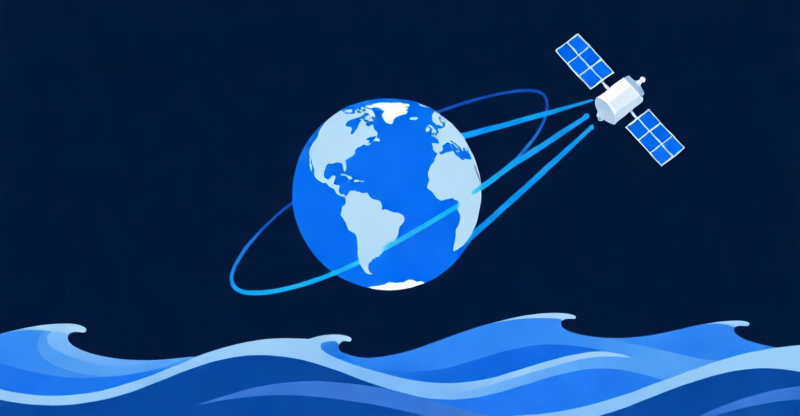
Iridium NTN NB-IoT 2026. Starlink D2C 1.8M+. Markt $1.82B->$15.77B.
Satellite IoT is not one thing. It is three architectures competing for different device classes: Direct-to-Cell (Starlink, AST SpaceMobile) connects unmodified phones via terrestrial spectrum — messaging today, broadband eventually. 3GPP NTN NB-IoT (Iridium, Skylo) connects IoT sensors via globally harmonized MSS spectrum — commercial launch in 2026. Proprietary satellite IoT (Iridium Edge, Globalstar) has been shipping for years — low-data-rate telemetry for assets beyond cellular range. The procurement decision is not "satellite or cellular" — it is "which satellite layer for which device class, at what airtime cost, with what fallback to terrestrial."
The Three Architectures
| Architecture | Providers | Devices | Data Rate | Latency | Power | Cost/Typical Use |
|---|---|---|---|---|---|---|
| ------------- | ----------- | --------- | ----------- | --------- | ------- | ----------------- |
| Direct-to-Cell (D2C) | Starlink, AST SpaceMobile | Unmodified phones/tablets | Text today, voice/data ~2027+ | Seconds to minutes | Phone-class (daily charge) | SMS: included in MNO plan; broadband: TBD |
| 3GPP NTN NB-IoT | Iridium (Project Stardust), Skylo | NTN-capable NB-IoT modules (Nordic, Qualcomm) | 2-40 kbps | 30-60 seconds per message | Ultra-low (PSM-compatible) | ~$3-8/month for 100-byte/hour telemetry |
| Proprietary satellite IoT | Iridium Edge, Globalstar, Orbcomm | Proprietary modules | 0.3-2.4 kbps | Minutes | Low (primary battery) | $5-15/month for daily location ping |
The key difference for IoT procurement: NTN NB-IoT uses the same 3GPP protocol stack as terrestrial NB-IoT. The device firmware does not need to know whether it is talking to a tower or a satellite. The SIM, the module, and the network handle the routing. This is the architecture that makes hybrid satellite-cellular viable at scale — one SKU, one SIM, one firmware build, two physical layers.
Iridium NTN NB-IoT — The IoT Standard That Launches in 2026
Iridium's Project Stardust adopted 3GPP NTN NB-IoT as its IoT standard in 2024. MNO trials began in summer 2025. Full commercial launch is 2026. Deutsche Telekom is integrating Iridium NTN for NB-IoT direct-to-device in 2026. Nordic Semiconductor is building Iridium NTN Direct into its modules.
The February 2026 Iridium 9604 module integrates satellite + cellular + GNSS into a single platform — 60% board space reduction versus discrete modules. It supports location-based network selection: cellular when available, satellite when not. For a soil sensor in rural Brazil, a container tracker in the South Atlantic, or a pipeline monitor in the Canadian Arctic, this means one module, one SIM, one data plan — with the physical layer switching transparently.
The cost: Iridium NTN NB-IoT airtime is projected at $3-8/month for a device transmitting 100 bytes/hour. Compare to Iridium Edge (proprietary) at $5-15/month for a daily location ping. NTN NB-IoT is cheaper per byte and more power-efficient because it uses the same PSM/eDRX mechanisms as terrestrial NB-IoT. The satellite is just another cell tower — with a 30-60 second latency penalty.
Source: The Mobile Network, "Iridium pushes on with satellite NB-IoT plans, targets 2026 launch", May 2025. Available at https://the-mobile-network.com/2025/05/iridium-pushes-on-with-satellite-nb-iot-plans-targets-2026-launch/
Starlink Direct-to-Cell — Messaging for Emergency, Not IoT Telemetry
Starlink D2C uses T-Mobile's terrestrial spectrum to deliver text messaging to unmodified phones via Starlink satellites. 1.8M+ subscribers as of early 2026. Partners include Rogers, Optus, One NZ, Salt, Kyivstar, Entel, KDDI. The use case is emergency messaging and SMS in areas without cellular coverage — not IoT sensor telemetry.
The limitation for IoT: Starlink D2C operates in terrestrial MNO spectrum, requiring country-by-country regulatory approval. It is designed for consumer phones, not power-optimized IoT modules. It does not support NB-IoT PSM/eDRX. For a sensor that wakes once per hour and transmits 100 bytes, Starlink D2C is the wrong tool — too power-hungry, too expensive per byte, and not designed for machine-to-machine traffic. For a vehicle emergency call button or a remote worker safety check-in, it is the right tool.
When Satellite IoT Pays for Itself
The procurement crossover: a cellular-only device in a location with no coverage generates zero data and requires a site visit to retrieve. A hybrid satellite-cellular device in the same location transmits data daily and never requires a site visit. The satellite airtime cost ($3-15/month) is compared against the amortized cost of a site visit ($200-500 per visit, including labor, travel, and downtime). If the device would require more than one site visit per year without satellite connectivity, satellite pays for itself.
For agriculture: a 500-hectare farm with 50 soil sensors beyond cellular range. Without satellite: data collected manually once per season. With satellite: daily data, irrigation optimized, yield improved 10-25%. Satellite airtime for 50 sensors at $5/month = $3,000/year. Yield improvement on $500,000 of crop output at 10% = $50,000. The ROI math is not in the connectivity cost — it is in the data that the connectivity enables.
Source: Bitget News / Iridium, "Iridium 9604: Wagering on the Hybrid IoT S-Curve", February 2026. Available at https://www.bitget.com/news/detail/12560605228528