Como los SIM Multi-IMSI Deciden Que Red Usar — La Logica de Direccion dentro de un Chip de 6mm
· 7 min read · Technical Whitepapers
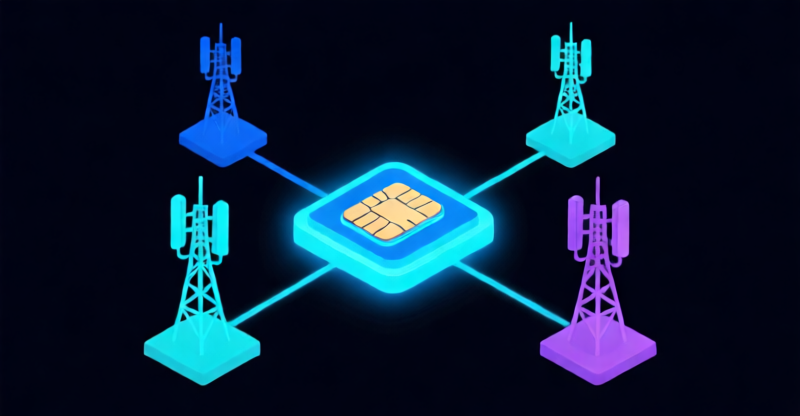
Un SIM multi-IMSI lleva 3-10 identidades en un solo chip. Un applet Java Card lee el archivo LOCI, verifica la IMSI actual contra las redes visibles y — si la red la rechaza — cicla a la siguiente IMSI, limpia la lista PLMN prohibida y reintenta.
Un dispositivo con SIM multi-IMSI enciende en Rotterdam. Su IMSI actual es un perfil Vodafone Países Bajos. El modem escanea PLMNs visibles — KPN, T-Mobile NL, Vodafone NL — y se adjunta en menos de 2 segundos. El mismo dispositivo, dos horas después, enciende en Estambul. Su IMSI Vodafone NL ahora es visitante en roaming. Turkcell rechaza la conexion. El applet SIM detecta el rechazo via el estado LOCI, cicla al siguiente IMSI (perfil local Turk Telekom), envia REFRESH al modem, limpia la lista FPLMN y reconecta. Tiempo total: ~45 segundos.
El Applet de Direccion: Sondeo LOCI y Ciclo REFRESH
La inteligencia reside en un applet SIM Toolkit (STK) — una aplicacion Java Card en la UICC. Cada 20-30 segundos el modulo celular envia un mensaje STATUS a la SIM. Cada 4 mensajes STATUS, el applet envia un comando PLI (Provide Local Information). El modulo responde con el archivo LOCI que contiene MCC, MNC, codigo de area y — lo mas importante — el Location Update Status. Si el estado no es UPDATED tras un timeout (2-3 minutos), el applet dispara la rotacion de IMSI.
Round-Robin vs Network-Steered
Round-robin: el applet mantiene una lista ordenada de IMSIs (3-10, precargados en fabrica). El IMSI actual falla → siguiente IMSI en secuencia. Simple, sin infraestructura backend. Network-steered: el mismo mecanismo round-robin pero con orden optimizado centralmente por el CMP segun precios mayoristas y SLA por pais.
Multi-IMSI + eUICC: La Arquitectura 2025
El SIM eUICC se carga con un perfil multi-IMSI como primario. El applet multi-IMSI maneja cambios rapidos diarios (90% de operaciones, sub-minuto). La capa eUICC permite descargar nuevos perfiles OTA cuando el dispositivo entra en paises sin IMSI cargado (10% restante).
Preguntas frecuentes
How fast does a multi-IMSI SIM switch networks?
First IMSI attempt: under 2 seconds if accepted. IMSI switch after rejection: 40 seconds to 5 minutes (the applet polls LOCI every 20-30 seconds, triggers after 2-3 minutes of non-UPDATED status). Full round-robin through 5 IMSIs: worst case 10-15 minutes. Network-steered (centralized) models tend toward the faster end because IMSI order is pre-optimized per country.
Does multi-IMSI require backend infrastructure?
Round-robin multi-IMSI requires zero backend — the applet runs entirely on the SIM. Network-steered multi-IMSI requires a CMP or core network platform to manage IMSI prioritization per country, but the switching itself is still applet-driven locally. The backend updates the preferred order every 1-3 months via OTA.
Why does my multi-IMSI device drain its battery searching for networks?
If no IMSI achieves connection after a full rotation cycle, the applet restarts the cycle indefinitely — continuously scanning PLMNs, attempting attaches, clearing FPLMN, and re-scanning. This consumes 2-5x idle power. The fix: a CMP policy that suspends rotation after N failed cycles and switches to low-duty-cycle search, or external power-cycle logic on the device.
Multi-IMSI or eUICC — which should I choose?
For known regional deployment with fast switching: multi-IMSI. For unknown global deployment with 10+ year lifecycle: eUICC. For maximum resilience: both — eUICC SIM loaded with a multi-IMSI profile as primary. Sub-minute switching for routine operations, OTA profile download for adding new carriers.
Referencias
- KORE Wireless — OmniSIM Reach: Centralized Multi-IMSI Architecture
- BICS — Multi-IMSI eSIM: A Comprehensive Guide (2025)
- Onomondo — Multi IMSI SIM Explained: A Technical Deep Dive for IoT
- Eseye — Understanding IMSI Rotation vs IMSI Switching
- Pelion — Multi-IMSI vs eUICC in IoT: Benefits, Differences and Risks (July 2025)
- ixt.io — Multi-IMSI and eUICC Explained: Resilient Connectivity for IoT (2025)