NB-IoT vs LTE-M: 8 dB que Deciden
· 8 min read · Technical Whitepapers
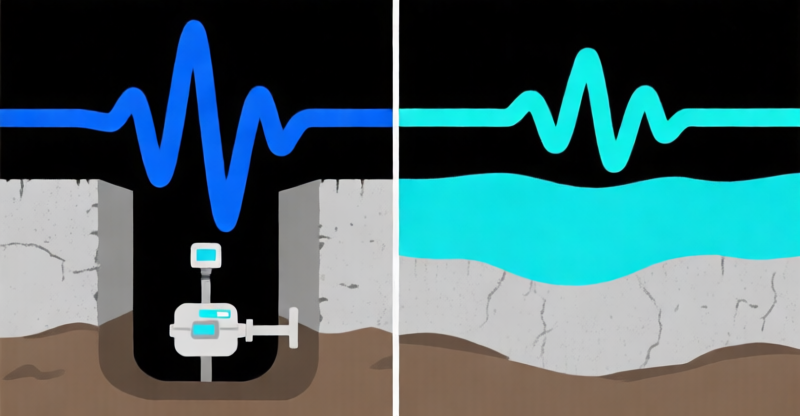
NB-IoT 8-9 dB mas. Funciona en sotanos. LTE-M: handover y FOTA.
NB-IoT y LTE-M comparten linaje 3GPP pero divergen donde importa para compras. NB-IoT tiene 8-9 dB mas de presupuesto de enlace (MCL 164 dB vs 155.7 dB) — funciona en bovedas subterraneas donde LTE-M falla a -113 dBm. LTE-M soporta handover de movilidad completo, VoLTE y throughput de 1 Mbit/s — maneja actualizaciones de firmware que tomarian horas en NB-IoT.
Lo Que Realmente Significan 8 dB Bajo Tierra
NB-IoT alcanza 164 dB MCL mediante ancho de banda estrecho (180 kHz), altos factores de repeticion (hasta 2,048x en modo CE2) y despliegue sub-1 GHz. LTE-M alcanza 155.7 dB — una brecha de 8.3 dB que equivale a 2-3 paredes de concreto. Un medidor de agua en un estacionamiento subterraneo en Berlin (-120 dBm) conecta en NB-IoT CE1. El mismo medidor en LTE-M puede no conectar.
PSM y eDRX: Las Funciones que los Operadores Pueden No Soportar
Ambas tecnologias soportan PSM (sueno profundo 3-10 µA) y eDRX (escucha periodica). Pero la implementacion del operador es clave. Verifique los valores reales de temporizadores PSM en la red objetivo antes de comprar SIMs.
Preguntas frecuentes
NB-IoT or LTE-M —which has better battery life?
NB-IoT has lower sleep current (3-10 µA vs 5-15 µA in PSM) and lower peak transmit current. But this advantage can be negated by CE level penalties: in CE2 mode (deep coverage), NB-IoT repeats transmissions up to 2,048 times, multiplying energy per payload. LTE-M at CE Mode A in good coverage may actually use less total energy for the same payload because it transmits once at higher power. The battery life answer depends on the device's RF environment, not just the technology spec.
Why does NB-IoT not support mobility handover?
NB-IoT was designed and optimized for stationary devices —smart meters, environmental sensors, parking space detectors. Cell reselection (reconnecting after signal loss) is the only mobility mechanism. LTE-M was designed to support handover, VoLTE, and mobility up to highway speeds. For any application where the device physically moves between cell coverage areas during operation, LTE-M is the correct specification.
Should I just use Cat-1 bis instead of choosing between NB-IoT and LTE-M?
For global roaming deployments where you cannot guarantee NB-IoT or LTE-M availability in every target market, Cat-1 bis is the pragmatic fallback —it runs on standard LTE networks without requiring LPWA-specific carrier support. The trade-off is higher power consumption than either NB-IoT or LTE-M. For battery-powered sensors with 5+ year life targets, NB-IoT or LTE-M is still preferred —but verify carrier support per country before committing.
Referencias
- Orlovs et al. —LPWAN Technologies for IoT: Real-World Deployment Performance (MDPI IoT Journal, 2025)
- Tele2 IoT —NB-IoT, LTE-M, Cat-1 bis: Choosing the Right Cellular IoT Technology (February 2026)
- Velos IoT —How eDRX and PSM Extend Battery Life in LTE-M and NB-IoT Devices (2026)
- Hologram.io —NB-IoT vs Cat-M1 vs Cat-1: How to Choose the Right LTE IoT Standard (2025)