eUICC IoT SIM Procurement in 2026: SGP.02 Dominance, SGP.32 Options, and the €0.005/MB Rate Floor
· 5 min read · Technical Whitepapers
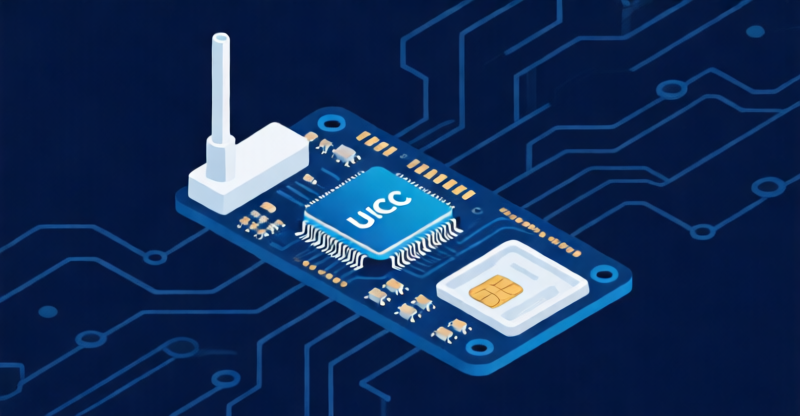
eUICC enables remote carrier switching, but 1B of 3.3B IoT shipments are RSP-capable. Data starts at €0.005/MB; profile certification, not hardware, is the timeline bottleneck.
eUICC is the GSMA-standardized software capability that lets a SIM hold and switch carrier profiles remotely, whether the SIM is plastic or soldered [2][8]. For a fleet planning cross-border operations, anchor the business case to 1 billion RSP-capable devices among 3.3 billion cellular IoT shipments forecast for 2023-2027 [7]. On published rate cards, data starts at €0.005/MB for low-consumption sensors and €1.50/GB for data-intensive links; buy catalog for pilots, project quote for volume [8].
WHY IT MATTERS
Before eUICC, procurement had to choose a carrier before hardware shipped, then live with that choice for the life of the device [2]. That control boundary has shifted: a device can now switch operator profiles remotely [2], and a local profile can be provisioned remotely to comply with country roaming rules, such as Brazil's limits on roaming duration [4]. But the installed base is not uniform: most eUICC SIMs in service run SGP.02, and the MVNO/MNO commercial frameworks are built around it, so migration to newer specs will lag the technology curve over multi-year lifespans [1].
For a buyer, the procurement-relevant number is the same 3.3 billion cellular-based IoT shipments forecast for 2023-2027, of which 1 billion are RSP-capable [7]. That scale changes SIM buying from a component purchase to a connectivity platform decision.
TYPICAL APPLICATIONS
Smart Metering and Sensors
Low-consumption devices such as smart meters and industrial sensors fit the €0.005/MB rate tier [8][4]. For these fleets, catalog pricing is usually enough because usage is predictable; a €15 SIM Test Kit with 1 GB over 12 months validates the eUICC/RSP flow before volume commits [8]. The operational buy is a CMP platform with REST APIs to automate SIM provisioning, policy enforcement, and lifecycle management [6].
Video Surveillance and POS
Data-intensive deployments such as video surveillance and POS terminals fall into the €1.50/GB tier [8]. eUICC hardware and profiles are quoted per project based on volume, so the purchasing trigger shifts from catalog to quote when you move from pilot to production [8]. If local traffic breakout matters for latency or in-country compliance, a provider offering multi-IMSI-over-eUICC with local points of presence is a relevant comparison point [6].
Multi-Country Fleets
A device built in Shenzhen can ship to a warehouse in Chicago and deploy elsewhere without a physical SIM swap [2]. Among the 3.3 billion cellular IoT shipments forecast for 2023-2027, 1 billion are RSP-capable, which makes remote provisioning a scale decision rather than a niche feature [7]. The fully digital eUICC journey eliminates the need to change SIMs when switching operator profiles [7]. For large fleets, buying a Global IoT SIM means buying remote provisioning, carrier agreements, and CMP tooling together, not just plastic or solder [6][8].
TECHNICAL SPECIFICATION / COMPARISON TABLE
The table separates what procurement actually buys: standard version, form factor, pricing trigger, and deployment context.
| Dimension | Traditional SIM | eUICC SGP.02 | eUICC SGP.32 |
|---|---|---|---|
| Form factor | Plastic card in device [1] | Plastic eUICC card or soldered eSIM [1][2] | Embedded MFF2, iSIM, softSIM offered by some providers [6] |
| Remote provisioning | Requires physical SIM swap [2] | Supported through MVNO/MNO frameworks; dominant standard today [1] | Supported; new IoT-focused spec for constrained devices [3] |
| Pricing trigger | Carrier contract, not published [8] | Catalog from €0.005/MB; project quote for volume [8] | Same eUICC pricing; project quote [8] |
| Deployment context | Legacy fleets | Most eUICC SIMs in service now [1] | RSP-capable devices: 1B of 3.3B shipments 2023-2027 [7] |
SELECTION NOTES
Choose SGP.02 when you must fit existing MVNO/MNO commercial frameworks and a large installed base; most eUICC SIMs in service run SGP.02 [1]. Choose SGP.32 when the device is network-constrained or UI-constrained and you need streamlined remote provisioning [3].
Catalog pricing is sufficient when you are validating a pilot with a known data profile: the €15 test kit covers 1 GB over 12 months, and pay-as-you-go rates start at €0.005/MB [8]. Move to project quote when you need volume eUICC hardware, custom profiles, multiple form factors (plastic, MFF2, iSIM, softSIM), or CMP integration; the cited sources state eUICC hardware and profiles are quoted per project based on volume [8][6].
COST MODEL / TCO
Unit Connectivity Costs
Based on publicly available rate cards, a sensor using 10 MB/month at €0.005/MB costs €0.05/month in data. A camera using 100 GB/month at €1.50/GB costs €150/month [8]. These rates are the catalog floor; actual TCO depends on profile volume and certification effort.
Hardware and Platform Costs
eUICC hardware and profiles are not published in public catalogs; they are project-quoted based on volume [8]. A standalone pilot path exists at €15 for 1 GB over 12 months [8]. CMP pricing is not published in the cited sources, but the platform scope is defined: provisioning, policy enforcement, diagnostics, rating/billing, and lifecycle automation via REST APIs [6].
Payback Logic
Procurement managers note that eSIM profile certification is the timeline bottleneck, not hardware. At the 1-billion-device scale forecast for RSP-capable devices, certification lead time per carrier profile matters more than per-unit SIM price [7]. The payback calculation should include certification lead time and the number of field SIM swaps avoided; both are deployment-specific and must come from your service operations data, not from a vendor rate card [8].
PROCUREMENT REALITY CHECK
A buyer comparing eUICC suppliers for a multi-country fleet should ask three questions with numbers attached: which GSMA spec the profiles run — SGP.02 or SGP.32 [1][3]; what certification lead time is quoted in weeks per carrier profile; and at what volume the pricing switches from catalog €0.005/MB or €1.50/GB to a project quote [8]. Procurement managers note that eSIM profile certification is the timeline bottleneck, not hardware, so schedule profile approval before hardware delivery, not after.
CATALOG PRICING VS PROJECT QUOTE
Catalog pricing is enough when you are piloting or running predictable low-consumption fleets: the 1 GB/12-month test kit costs €15, and sensor-class data starts at €0.005/MB [8]. Project quote is required when you scale volume eUICC hardware, need custom carrier profiles, use multiple form factors, or integrate a CMP Aggregator across multi-vendor fleets [6][8].
eUICC procurement specifications
| Parameter | Value | Business Impact |
|---|---|---|
| RSP-capable device forecast | 1B of 3.3B cellular IoT shipments 2023-2027 | Justifies eUICC investment at fleet scale [7] |
| Low-consumption data rate | From €0.005/MB | Sensor and smart-meter cost baseline [8] |
| Data-intensive rate | From €1.50/GB | Video/POS quote baseline [8] |
| Pilot validation kit | €15 for 1 GB over 12 months | Low-cost catalog entry point [8] |
| Profile certification | Timeline bottleneck per procurement managers | Schedule certification before hardware |
eUICC vs traditional SIM procurement comparison
| Dimension | Option A | Option B | When to Choose |
|---|---|---|---|
| Carrier switching | Traditional SIM: physical replacement [2] | eUICC: remote profile switching [2] | Choose eUICC for multi-country fleets |
| Pricing | Carrier contract, not published [8] | Catalog from €0.005/MB; €1.50/GB; test kit €15 [8] | Catalog for pilots; project quote for volume |
| Standard fit | No RSP standard | SGP.02 for existing M2M; SGP.32 for constrained devices [1][3] | SGP.02 for installed base; SGP.32 for new constrained fleets |
| Installed base context | Legacy deployments | 1B RSP-capable devices of 3.3B shipments [7] | Plan certification lead time at fleet scale |
Frequently Asked Questions
What is the difference between eUICC, eSIM, and a traditional SIM for IoT procurement?
eUICC is the software capability that makes a SIM remotely reprogrammable; eSIM is the physical embedded form factor; a traditional SIM has one carrier profile and requires a physical swap to change networks [2]. For procurement, the difference is contract type: eUICC allows one SIM to serve multiple countries, but most eUICC SIMs in service today run SGP.02 [1].
What are the main challenges when deploying eUICC SIMs in IoT devices?
The installed base mostly runs SGP.02, with MVNO/MNO commercial frameworks built around it, so change is slow [1]. Procurement managers note that eSIM profile certification is the timeline bottleneck, not hardware. Also, eUICC hardware and profiles are project-quoted based on volume, not listed in public catalogs [8].
How does multi-IMSI-over-eUICC address eUICC challenges?
It combines multiple IMSIs on one eUICC profile with local points of presence, letting traffic break out regionally for lower latency and in-country compliance [6]. That can help meet country roaming restrictions, such as Brazil requiring a local profile after a set roaming period [4].
How does eUICC enhance IoT device functionality?
It enables over-the-air carrier switching to adjust for coverage, cost, or business needs [6]. It also removes the need to physically change SIMs when changing operators [7]. Use cases include smart meters, industrial sensors, and connected appliances [4].
What components make up an eUICC Remote SIM Provisioning platform?
The platform side is a Connectivity Management Platform that unifies SIM provisioning, policy enforcement, diagnostics, rating and billing, and lifecycle automation, exposed through REST APIs [6]. On the SIM side, each loaded profile has its own ICCID [1].
Which eUICC standard should I choose for a new IoT deployment in 2026?
For existing managed fleets, SGP.02 remains the dominant standard for plastic eUICC SIMs [1]. For constrained, UI-less devices, SGP.32 is the newer IoT-focused spec that streamlines remote provisioning [3]. Certification lead time, which procurement managers flag as the bottleneck, should drive the schedule.
What is UICC in the context of eUICC procurement?
UICC is the Universal Integrated Circuit Card — the substrate that holds SIM identities. eUICC adds remote provisioning so profiles can be switched over-the-air [2][8]. In practical procurement terms, eUICC hardware and profiles are quoted per project; a 1 GB/12-month test kit costs €15 [8].
References
- eUICC SIMs, eSIM Routers and the Specs That Matter: IoT Guide 2026
- 5 benefits of building with eUICC
- Introduction to IoT eUICC (eSim) - IoT SIM Card | 1NCE
- iSIM vs eSIM vs eUICC: What Is iSIM and How Does It Work?
- eUICC SIMs: A New IoT Opportunity for Equipment...
- Best eUICC SIM for IoT Connectivity: Top 5 Options in 2026
- Introduction to IoT eUICC (eSim) - IoT SIM Card – 1NCE IoT Connectivity
- Global IoT eSIM (eUICC): SGP.32, Pricing, Multi-Carrier | iot.cards