GPS Tracker Fleet Connectivity Rollout: $10–$50 per Vehicle, One Global IoT SIM, and CMP Operations
· 6 min read · Case Studies
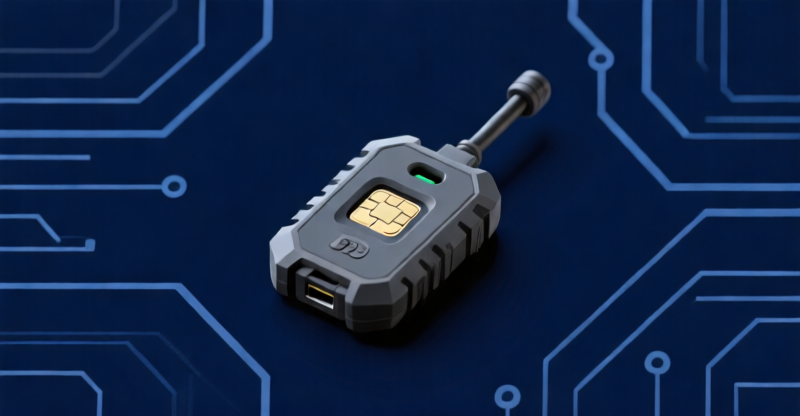
GPS fleet connectivity costs $10–$50/vehicle/month; one IoT SIM and CMP contract avoids multi-country procurement and exposes 3–8 weeks TRC registration work.
GPS tracker fleet connectivity rollout is the process of procuring, provisioning, and managing the cellular connectivity layer—SIMs, data plans, and a connectivity management platform (CMP)—for fleet telematics devices. For a 50-vehicle deployment, standard GPS tracking subscriptions typically run $10–$50 per vehicle per month (GPSTab, 2026 [1]), making recurring connectivity the largest line item before hardware. That is why the choice of global IoT SIM and CMP platform determines both cost and rollout timeline.
WHY IT MATTERS
Fleet connectivity is no longer experimental: IoT fleet management reached $20.4 billion in 2024, and more than 40 million commercial vehicles now use IoT-based telematics (Keystone Corp, 2026 [2]). The procurement constraint has shifted from 'which GPS device' to 'how the SIM and CMP handle cross-border handoffs, SIM lifecycle changes, and invoicing across countries.'
A GPS tracker that cannot transmit is not tracking; it is recording locally while the platform shows nothing (KORE, 2026 [7]). For a 50-vehicle fleet, this risk multiplies in every corridor where the primary carrier lacks coverage. Multi-carrier SIM infrastructure exists specifically to maintain consistent GPS reporting when the vehicle crosses carrier corridors (KORE, 2026 [7]).
TYPICAL APPLICATIONS
Cross-Border Freight and Logistics
Fleet devices move across regions and countries, requiring smooth handoffs between cellular towers and carriers (Hologram, 2026 [5]). For fleets expanding abroad, fragmented per-country operator contracts do not scale past a handful of markets. One multi-network SIM, one contract, one invoice, and one CMP platform covers a fleet management company moving from one country to fifteen without a new procurement cycle (Com4, 2026 [6]). Product path: Global IoT SIM plus CMP platform.
Mixed-Asset Tracking
One published fleet runs telematics on 12 trucks and low-cost trackers on 80+ trailers, generators, and tool carts, cutting total tracking spend by 60% (AirPinpoint, 2026 [8]). For procurement, this points to a hardware-neutral platform that supports existing devices instead of forcing replacements; Flotilla lists 2,000+ GPS device models supported (Flotilla, 2026 [3]). Product path: catalog pricing for the software layer, project quote for connectivity if you need custom SIM logistics.
Pilot-to-Production Scaling
Pay-as-you-go connectivity from ~€0.001/MB with no minimum contract makes a pilot rollout realistic before committing fleet-wide (Com4, 2026 [6]). A managed platform lets operations teams provision new devices, manage SIM lifecycles, and adjust data plans programmatically without proportional increases in IT overhead as the fleet grows (KORE, 2026 [7]). Product path: catalog pricing for pilot, project quote when you need API-based provisioning at scale.
TECHNICAL SPECIFICATION / COMPARISON TABLE
Based on publicly available data, the comparison below puts a 50-vehicle fleet on the hook for thousands of dollars in annual difference depending on the connectivity and management model.
| Dimension | Standard GPS tracking | Advanced telematics | Hybrid asset tracking |
|---|---|---|---|
| Monthly subscription | $10–$50 per vehicle (GPSTab, 2026 [1]) | Can exceed $80 per vehicle (GPSTab, 2026 [1]) | 60% lower total spend in one published 12-truck + 80-asset fleet (AirPinpoint, 2026 [8]) |
| Platform software | From $2 per vehicle/month (Flotilla, 2026 [3]) | $30+ per vehicle/month in traditional bundled model (AirPinpoint, 2026 [8]) | $30+ on primary vehicles, 60% lower total spend with 80+ low-cost assets (AirPinpoint, 2026 [8]) |
| Connectivity contract | One SIM/contract/invoice across 15 countries (Com4, 2026 [6]) | 15-country one-contract plus programmatic SIM lifecycle management (KORE, 2026 [7]) | Same 15-country connectivity layer plus 80+ low-cost asset trackers (AirPinpoint, 2026 [8]) |
| Device support | Hardware-neutral platforms support 2,000+ devices (Flotilla, 2026 [3]) | 2,000+ devices including CAN bus, OBD, fuel, temperature sensors (Flotilla, 2026 [3]) | 12 primary telematics plus 80+ AirTags on trailers (AirPinpoint, 2026 [8]) |
SELECTION NOTES
When catalog pricing is sufficient: if your fleet is 50 or fewer vehicles, operates in one country or one multi-country corridor, and does not require regulator-to-carrier registration reconciliation, buy from the published $2–$50 per vehicle/month range (Flotilla, 2026 [3]; GPSTab, 2026 [1]).
When a project quote is required: if you are crossing more than five countries, need one contract and one invoice (Com4, 2026 [6]), need API-driven (RESTful M2M) SIM lifecycle management to reduce IT overhead (KORE, 2026 [7]), or need to reconcile a national regulator's device list with a carrier's billing system, request a project quote. For eSIM-capable suppliers, ask for the remote provisioning workflow in that quote; the cited sources document multi-network SIM with CMP management, not eSIM-specific performance claims.
PROCUREMENT REALITY CHECK
From the Field: The TRC Registration Reconciliation
Procurement managers note that the biggest hidden cost in Jordanian deployments is the 3–8 weeks of engineering time spent reconciling the TRC registration list with the local carrier's billing system. This is not a hardware cost or a SIM unit cost; it is cross-functional labor that appears after signature.
For a procurement team comparing global IoT SIM options, the practical question to ask each supplier is: who owns the registration-to-activation workflow in countries with national device registries? If the answer is 'the integrator,' the 3–8 week reconciliation window becomes the critical timeline item. If the answer is 'the CMP has an API for registration status,' that saves engineering time and should be a selection criterion (KORE, 2026 [7]).
COST MODEL / TCO
Hardware Costs
Hardware unit prices are not itemized in the cited sources; the one published data point is that traditional proprietary hardware plus cellular subscriptions runs $30+ per vehicle/month (AirPinpoint, 2026 [8]). Budget hardware as a one-time line item and use a hardware-neutral platform if you want to avoid replacing existing trackers (Flotilla, 2026 [3]). Install and maintenance are not itemized in the cited sources; include them in the project quote and subtract them from the 60% potential savings.
Connectivity and Platform Costs
Monthly subscriptions are the largest recurring cost: $10–$50 per vehicle for standard tracking, and over $80 for advanced telematics (GPSTab, 2026 [1]). Platform-only pricing starts at $2 per vehicle/month (Flotilla, 2026 [3]). Usage-based connectivity can start at ~€0.001/MB with no minimum (Com4, 2026 [6]), which suits low-data location pings but not high-frequency video or engine data.
Total Cost and Payback
Using the published hybrid example, moving 12 primary trucks with telematics and 80+ trailers with low-cost trackers cut total tracking spend by 60% (AirPinpoint, 2026 [8]). For a fleet spending $30 per vehicle/month on the traditional model, a 60% reduction saves $18 per vehicle/month, or $10,800 per year for 50 vehicles. That payback covers the engineering time spent on regulator-to-carrier reconciliation in roughly one year if that time costs the same amount.
CATALOG PRICING VS PROJECT QUOTE
Catalog pricing is enough when your deployment is a single-country pilot under 50 vehicles, no national device registry is involved, and you can accept a standard $10–$50 per vehicle/month subscription (GPSTab, 2026 [1]) or platform pricing from $2 per vehicle/month (Flotilla, 2026 [3]).
A project quote is required when you need one contract and one invoice across five or more countries (Com4, 2026 [6]), when you need programmatic SIM lifecycle management and API provisioning (KORE, 2026 [7]), or when a national regulator's registration list must be reconciled with a carrier's billing system. The quote should include CMP platform fees, API integration effort, and a registration workflow timeline—not just SIM unit price.
Specifications
| Param | Value | Business Impact |
|---|---|---|
| Standard tracking subscription | $10–$50 per vehicle/month (GPSTab, 2026 [1]) | Drives the recurring IoT SIM budget |
| Advanced telematics subscription | Over $80 per vehicle/month (GPSTab, 2026 [1]) | Budget 2–4x standard when video/AI is included |
| Usage-based connectivity | From €0.001/MB, no minimum (Com4, 2026 [6]) | Lets pilot run before fleet-wide commitment |
| CMP platform pricing | From $2 per vehicle/month (Flotilla, 2026 [3]) | Low-cost entry for hardware-neutral fleets |
Fleet Connectivity Comparison
| Dimension | Standard GPS | Global IoT SIM + CMP | When to Choose |
|---|---|---|---|
| Monthly cost | $10–$50/vehicle (GPSTab, 2026 [1]) | From $2/vehicle platform + €0.001/MB (Flotilla, 2026 [3]; Com4, 2026 [6]) | Standard for <50 vehicles; CMP-based for multi-country |
| Contract model | Local carrier contract | One contract/invoice across 15 countries (Com4, 2026 [6]) | Choose CMP for cross-border expansion |
| SIM lifecycle | Manual SIM swaps | Programmatic provisioning and data plan adjustments (KORE, 2026 [7]) | Choose CMP for fleets scaling on demand |
| Device compatibility | Proprietary hardware often required | Hardware-neutral with 2,000+ device support (Flotilla, 2026 [3]) | Choose CMP to avoid replacing existing trackers |
Frequently Asked Questions
What is IoT fleet management?
IoT fleet management combines GPS location, engine diagnostics, fuel consumption, idle time, driver behavior scores, and cargo condition data into dashboards (KORE, 2026 [7]). The market reached $20.4 billion in 2024, and over 40 million commercial vehicles use IoT telematics (Keystone, 2026 [2]).
What insights can IoT fleet solutions provide?
The cited sources show IoT fleet platforms aggregate GPS location, engine diagnostics, fuel consumption, idle time, driver behavior scores, and cargo condition data into dashboards (KORE, 2026 [7]). That data supports tighter, safer, and more cost-efficient operations (KORE, 2026 [7]).
What is the best type of IoT connectivity for cross-border fleet management?
A multi-network cellular SIM paired with one contract, one invoice, and one CMP platform is the model Com4 recommends for fleets expanding from one country to fifteen (Com4, 2026 [6]). KORE adds that multi-carrier SIM infrastructure helps maintain consistent GPS reporting when the vehicle crosses carrier corridors (KORE, 2026 [7]).
Can IoT fleet management scale for large operations?
Yes. Some platforms report unlimited scalability with white-label and reseller support and compatibility with 2,000+ GPS device models (Flotilla, 2026 [3]). On the connectivity side, a managed platform lets teams provision devices and adjust data plans programmatically without proportional IT overhead (KORE, 2026 [7]).
How much does a GPS fleet connectivity rollout cost per vehicle?
Published 2026 pricing puts standard tracking at $10–$50 per vehicle per month (GPSTab, 2026 [1]), advanced telematics above $80 per vehicle per month (GPSTab, 2026 [1]), and some platform-only pricing at $2 per vehicle per month (Flotilla, 2026 [3]). Usage-based connectivity can start at ~€0.001/MB with no minimum (Com4, 2026 [6]).
How does eSIM technology benefit fleet operations?
The cited sources do not quantify eSIM-specific benefits; they document multi-network cellular SIMs with CMP management (Com4, 2026 [6]; KORE, 2026 [7]). For procurement, ask the supplier for an eSIM management workflow if you need remote profile changes, and compare it against a physical multi-network SIM with one contract and one invoice.
References
- GPS Fleet Tracking Cost: 2026 Pricing Guide - GPSTab
- IoT Fleet Management Buyer’s Guide for Logistics (2026) - Keystone
- Best Fleet Management Software 2026 - Flotilla IoT
- IoT Connectivity for Asset Tracking: 2026 Guide - Choice IoT
- Choosing an IoT data plan: A guide for fleet operators - Hologram
- IoT in Fleet Management: The Complete 2026 Guide - Com4
- IoT Connectivity for Fleet Management - KORE
- IoT Fleet Management: What It Actually Costs and How It Works - AirPinpoint