Pakistan HVAC IoT SIM Guide: 500-Controller eSIM Compliance and TCO
September 21, 2026 · 10 min read · Regional Info
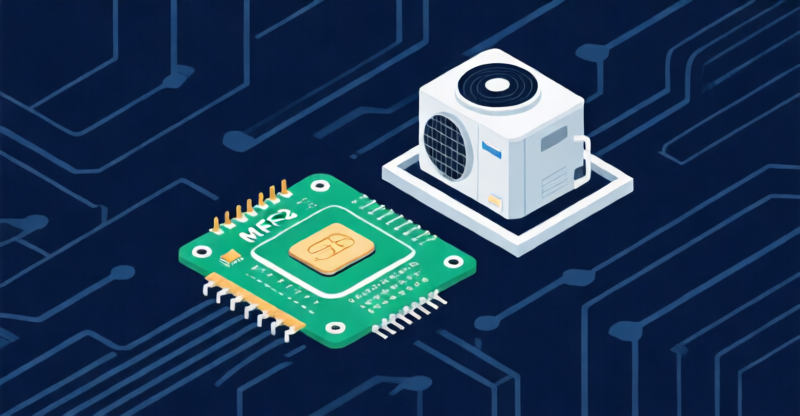
eSIM vs physical SIM for HVAC controls in Pakistan: carrier switching, compliance evidence and a 500-controller TCO at $0.60-$3.00 per device per month.
IoT SIM deployment for HVAC controls in Pakistan means choosing the SIM form factor, the carrier profile and the management platform that keep chillers, air handlers and cold-room controllers reporting temperature and compressor telemetry. For a 500-controller estate, remote eUICC profile switching removes the manual SIM handling step on every unit, an operational change worth more than 12 months of connectivity at published carrier rate cards of $0.60-$3.00 per device per month.
WHY IT MATTERS
The constraint that changed is logistics, not radio. Traditional SIM cards require manual activation before they connect, which at 500 cards means hundreds of individual activation steps or work across carrier portals with different interfaces [3]. With an eUICC, the carrier profile is downloaded over the air, so a carrier change across a 5-year service life becomes a software action rather than a parts order [1].
Permanent roaming restrictions and local-connectivity mandates are the two regulatory triggers that force profile changes mid-contract, and eSIM is cited specifically as the mechanism that lets a fleet respond without hardware adjustment [6]. For a Pakistani estate of 200 rooftop controllers, that converts a hardware re-procurement into a profile download, with no card stock and no site visit [1].
Compliance is a pre-production gate, not a post-deployment fix. Published vendor guidance is explicit: before production, confirm compliance with government and carrier regulations and ask providers about their compliance policies [4][7]. That conversation should end in writing, because the answer decides whether 1 global profile can serve a Pakistan site or whether 1 local profile per operator is required [6].
HVAC APPLICATIONS THAT DRIVE SIM CHOICE
Cold Rooms and Pharmaceutical Cooling
Cold rooms and pharmaceutical coolers are the HVAC segment where connectivity records carry regulatory weight. Deployment teams report that carrier identity logs become the audit trail for cold-chain compliance, which means the CMP must retain per-device carrier identity and session timestamps and expose them through a RESTful M2M API rather than a dashboard export. A controller sampling every 5 minutes generates about 8,640 records per device per month, and the audit trail must be queryable at that granularity.
Rooftop Units, VRF and Split Systems
Rooftop units, VRF systems and split systems typically move 10-100 MB per device per month based on published carrier rate cards, because the payload is setpoint, return-air temperature and fault codes rather than video. At that volume the SIM line item is rarely the cost driver; the installation visit is. LTE-M and NB-IoT remain the standard LPWAN options supported by carrier-agnostic eUICC providers [7].
Industrial Process Cooling and District Cooling
Process cooling and district cooling plants push higher payloads once vibration trending or thermal imaging is added. 5G RedCap sits between LTE-M and high-bandwidth 5G and is positioned for industrial sensors and video where full 5G module cost is not justified [2]. If a plant wants compressor vibration spectra every 15 minutes, size the 5G IoT SIM module for that payload before signing a 36-month connectivity contract.
Multi-Site Retail and Hospitality Estates
Multi-site estates of 20 or more properties usually want local breakout so traffic does not hairpin through another region. Multi-IMSI-over-eUICC SIMs combined with local points of presence let traffic break out regionally for lower latency and cost [5]. Ask for the PoP location list inside the quote, because that is a network architecture answer, not a SIM answer.
PAKISTAN CARRIER LANDSCAPE AND REGULATORY FILE
Multi-Carrier eUICC Versus a Single Local Profile
For a global IoT SIM programme, the Pakistani question is whether one profile covers every site or whether a locally issued profile is required. Multi-carrier eUICC SIMs exist precisely to keep network redundancy across carrier territories without multiple SKUs [2], and regional carriers can be added without hardware changes [6]. The decision is commercial and regulatory, not technical: profile count, 12-month versus 36-month term, data pool size and local presence drive the price.
What the Cited Sources Do and Do Not Establish About Pakistan
The sources referenced here are global vendor and platform guidance; none of them publishes Pakistan-specific licensing, IMSI or permanent-roaming rules. The procurement-safe position is to require a written compliance statement from the connectivity provider covering the 1-3 markets in scope, because published guidance places that confirmation on the provider before production [4][7]. Treat any verbal assurance as an open item on the RFP response rather than a closed requirement.
eSIM Compliance and Standards Evidence
GSMA Remote SIM Provisioning and ETSI SIM specifications are the two baseline families for eUICC products, and GSMA IoT SAFE defines the SIM or eSIM as a hardware root of trust for device-to-backend authentication [5]. SGP.32 is the GSMA specification named for eSIM remote provisioning in IoT, and conformance to it is what makes carrier certification of a module repeatable [6]. Ask for the module GSMA certification evidence in the same pack as the M2M SIM quote.
TECHNICAL SPECIFICATION AND COMPARISON TABLE
The table compares the two procurement paths on dimensions that change contract structure rather than marketing claims. Values are ranges based on published carrier rate cards and distributor list pricing; site-specific radio coverage in Pakistan requires a field survey and a project quote.
| Dimension | Physical Multi-IMSI SIM | eUICC eSIM (GSMA SGP.32) | Procurement Trigger |
|---|---|---|---|
| Profile change mechanism | Manual swap or portal activation per card [3] | Over-the-air profile download [1] | More than 50 devices or sites over 4 hours travel |
| Carrier switch without site visit | Not supported at profile level | Supported for the device service life [7] | Any contract with permanent-roaming exposure [6] |
| Supply chain | Card stock held per operator SKU | One soldered part, profiles ordered just in time [5] | Build volumes above 1,000 units per year |
| Standards basis | GSMA Remote SIM Provisioning [5] | GSMA SGP.32 and ETSI SIM specs [5][6] | Carrier certification required at module level |
| Security basis | SIM as credential store | Hardware root of trust under GSMA IoT SAFE [5] | Device-to-backend authentication in scope |
| Radio access | 2G, 3G, 4G LTE, Cat-M1, Cat-1, NB-IoT [7] | Same options plus 5G RedCap on capable modules [2][7] | Payload above 100 MB per device per month |
| Monthly data envelope | Typ. 10-100 MB per device, published carrier rate cards | Typ. 10 MB-2 GB per device by payload, published carrier rate cards | Metering or video payloads |
| Card lifecycle | Physical inventory, loss and replacement handling | No physical inventory after assembly [1] | Sites with restricted access or sealed enclosures |
SELECTION NOTES
When device count is under 100 and every site sits within a 4-hour drive of a technician, a physical multi-IMSI SIM on catalog pricing is the lower total cost, because the SIM cost is a rounding error against the install visit.
When the fleet is above 50 devices spread across more than one province, or a site visit takes over 4 hours of travel, choose eUICC. The avoided manual activation and swap work is the payback, not the data rate [1][3].
When the controller ships inside a sealed, potted HVAC enclosure with a 5-year service expectation, specify a soldered MFF2 eSIM and remove the connector entirely, so the device is carrier-agnostic from the factory [6].
When payload exceeds 100 MB per device per month, or video and vibration spectra are in scope, quote 5G RedCap modules plus a matching 5G IoT SIM data band rather than LTE-M, because RedCap cuts module cost against full 5G while covering that bandwidth band [2].
When one connectivity provider serves multiple countries including Pakistan, request local breakout PoPs and multi-IMSI configuration in the same quote, since that combination is what keeps IoT roaming latency and cost regional [5].
PROCUREMENT REALITY CHECK: COLD-CHAIN AUDIT TRAILS
Scenario: a building-services contractor runs rooftop and cold-room HVAC controls across several Pakistani sites and must produce cold-chain evidence for a client audit. The file is not built from BMS trend logs; deployment teams report that carrier identity logs become the audit trail for cold-chain compliance. The practical consequence is that the connectivity platform, not the BMS, decides whether the evidence can be produced at all.
From the field: deployment teams report that carrier identity logs become the audit trail for cold-chain compliance. In procurement terms that turns two vendor questions into contract terms: does the CMP retain per-device carrier identity and session records, and can those records be pulled by API into the client archive without manual export? If either answer is no, the SIM price is irrelevant to the audit.
Vendor selection follows from that. Score connectivity providers on 3 criteria first, carrier-identity export completeness, API availability and written compliance coverage for Pakistan, then score price. A provider that wins on price but cannot produce the identity log has shifted compliance risk back onto the contractor.
COST MODEL / TCO
Hardware
Per control unit, a soldered embedded SIM chip (MFF2 eUICC) typically runs $1.50-$4.00 and an industrial M2M SIM card $2.00-$6.00 based on distributor list pricing. An LTE Cat-1 or Cat-M1 module with an eUICC interface typically adds $18-$45 per controller, and a 5G RedCap module sits above that band. For 500 controllers, the eSIM hardware line alone is roughly $750-$2,000.
Connectivity
Connectivity for HVAC telemetry typically lands between $0.60 and $3.00 per device per month at fleet sizes between 100 and 5,000 units, based on published carrier rate cards; volume bands and data pooling move the number more than radio technology does. A 500-device fleet at a $1.20 rate is about $7,200 per year, which is the recurring line most exposed to IoT roaming policy changes [6].
Platform, CMP and API
A CMP platform adds roughly $0.10-$0.50 per device per month based on published vendor pricing, and that is where IoT SIM management, eUICC profile ordering and identity-log export live [5][8]. The RESTful M2M API is the integration point pushing session and carrier-identity records into a compliance archive, so treat API rate limits and retention as commercial terms, because they decide how much of the audit trail is automatable.
Install, Maintenance and Payback
Commissioning a cellular HVAC controller at site typically costs $25-$70 in labour once travel is included, based on published service rates. One avoided site visit so covers 8 to 23 months of connectivity at $3.00 per device per month, which is the arithmetic behind remote profile switching in cellular IoT [1]. Maintenance is dominated by SIM replacement and re-provisioning events, both of which fall toward zero when the profile is delivered over the air [7][8].
| Cost Line | Unit | Low | High | Basis |
|---|---|---|---|---|
| eUICC MFF2 chip | per device | $1.50 | $4.00 | Distributor list pricing |
| Industrial M2M SIM card | per device | $2.00 | $6.00 | Distributor list pricing |
| LTE Cat-1 or Cat-M1 module | per device | $18 | $45 | Distributor list pricing |
| Connectivity, HVAC telemetry | per device/month | $0.60 | $3.00 | Published carrier rate cards |
| CMP platform line | per device/month | $0.10 | $0.50 | Published vendor pricing |
| Commissioning labour at site | per visit | $25 | $70 | Published service rates |
| Avoided truck roll | per event | $25 | $70 | Published service rates |
WHEN CATALOG PRICING IS ENOUGH, AND WHEN TO REQUEST A PROJECT QUOTE
Catalog pricing is enough when the deployment is standard: one country, one profile family, fewer than 100 devices, a data envelope under 100 MB per device per month, and a CMP with published per-device pricing. In that shape a self-serve IoT data plan plus an off-the-shelf eUICC SIM covers the requirement, and the M2M connectivity line stays minor against module and install cost [7][8].
A project quote is required when any of these hold: devices span multiple countries or Pakistani regions with different roaming treatment, profile count exceeds one, the audit requirement includes carrier-identity retention, the term exceeds 24 months, or volume exceeds 1,000 units. Those conditions move pricing off rate cards into negotiated data pools, committed-volume ladders and compliance warranties [3][6].
Run that boundary deliberately. Procure the first 50-100 devices at catalog pricing to validate radio coverage and CMP integration, then take the validated bill of materials to a project quote for production volume, because pilot data is what converts a rate card into a defensible unit price [3].
References
- How to Manage Global IoT SIMs in 2026
- Best IoT SIM for Large Scale Deployment: 2026 Buying Guide
- Managing Global IoT SIM Cards in 2026
- eSIM deployments for cellular IoT: A complete guide
- Best eUICC SIM for IoT Connectivity: Top 5 Options in 2026
- The OEM's Guide to eSIMs: How to Leverage eUICC Technology for Flexibility at Scale
- IoT SIM Management: The Complete Guide