NB-IoT vs LTE-M: The 8 dB Gap That Decides Whether Your Device Lives Underground or Dies Trying
· 8 min read · Technical Whitepapers
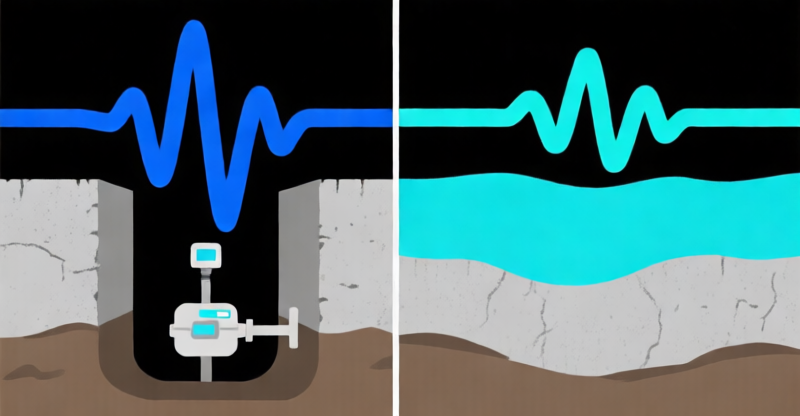
NB-IoT and LTE-M are both 3GPP LPWA standards —but the 8-9 dB link budget gap between them means NB-IoT works in a basement water meter where LTE-M fails at -113 dBm. LTE-M handles mobility and firmware updates that NB-IoT cannot. PSM sleep current: NB-IoT at 3-10 µA, LTE-M at 5-15 µA. But CE Level 2 in a deep basement can burn more energy than LTE-M in open air. Carrier PSM timer configuration matters more than the technology choice.
TL;DR: NB-IoT and LTE-M share a 3GPP lineage but diverge where it matters for procurement. NB-IoT has an 8-9 dB link budget advantage (MCL 164 dB vs 155.7 dB) —it works in underground vaults where LTE-M fails at -113 dBm. LTE-M supports full mobility handover, VoLTE, and 1 Mbit/s throughput —it handles firmware updates that would take NB-IoT hours. The choice is not "which is better" —it is "will this device ever move, and how deep underground will it be installed?" For stationary sensors in basements: NB-IoT. For anything that moves or needs firmware updates: LTE-M. For global roaming where neither is consistently available: Cat-1 bis.
The Numbers: What 8 dB Actually Means Underground
NB-IoT achieves 164 dB Maximum Coupling Loss (MCL) through a combination of narrow bandwidth (180 kHz), high repetition factors (up to 2,048x in CE2 mode), and sub-1 GHz frequency deployment (typically Band 5/8/20). LTE-M achieves 155.7 dB MCL —an 8.3 dB gap that translates to approximately 2-3 concrete walls or 1-2 additional floors of underground penetration.
In real deployment terms: a water meter installed in a basement parking garage in Berlin (-120 dBm path loss) will connect on NB-IoT at CE1 with moderate repetition. The same meter on LTE-M at the same location may not connect at all —LTE-M fails beyond approximately -113 dBm. If the meter is in a sub-basement equipment room with reinforced concrete (-130 dBm), NB-IoT at CE2 still connects (with higher energy cost due to repetition). LTE-M has no path.
The trade-off: NB-IoT in CE2 mode consumes several times more energy per transmission than in CE0 —the repetition that enables deep coverage also burns battery. A sensor transmitting once per day in CE2 may last 5-7 years on a 2,400 mAh cell; the same sensor in CE0 could last 12+ years. The coverage that saves the deployment also constrains the battery budget.
Source: Orlovs et al., "LPWAN Technologies for IoT: Real-World Deployment Performance and Practical Comparison", MDPI IoT Journal, 2025. Available at https://www.edi.lv/publications/lpwan-technologies-for-iot-real-world-deployment-performance-and-practical-comparison/
PSM and eDRX: The Power-Saving Features That Carriers May Not Support
Both NB-IoT and LTE-M support Power Saving Mode (PSM) and Extended Discontinuous Reception (eDRX). The specifications are clear. Carrier implementation is not.
PSM: the device enters deep sleep (3-10 µA for NB-IoT, 5-15 µA for LTE-M) while remaining registered on the network. It wakes at a configurable T3412 timer interval —anywhere from minutes to ~400 days. During PSM sleep, the device is unreachable for downlink data. This is the mechanism that enables 10+ year battery claims for smart meters.
eDRX: the device sleeps but wakes periodically to listen for paging messages. NB-IoT supports eDRX cycles up to ~3 hours; LTE-M up to ~40 minutes. eDRX provides a middle ground between PSM (unreachable) and continuous listening (battery drain) —useful when the server occasionally needs to reach the device within a known time window.
The critical caveat from Hologram.io (2025): "These highly touted features may not live up to their promises because carriers might not fully support them." Many MNOs implement only a subset of PSM/eDRX timers —particularly for roaming devices where the visited network overrides the home network's PSM configuration. Before procuring SIMs for an NB-IoT or LTE-M deployment, verify that your connectivity provider can confirm the actual PSM and eDRX timer values supported on the target network —not just that the network "supports NB-IoT."
Source: Velos IoT, "How eDRX and PSM Extend Battery Life in LTE-M and NB-IoT Devices", 2026. Available at https://velosiot.com/how-edrx-and-psm-extend-battery-life-in-lte-m-and-nb-iot-devices/
Source: Hologram.io, "NB-IoT vs Cat-M1 vs Cat-1: How to Choose the Right LTE IoT Standard", 2025. Available at https://www.hologram.io/blog/nb-iot-vs-cat-m1-vs-cat-1/
Mobility: The Feature NB-IoT Does Not Have
NB-IoT was designed for stationary devices. It does not support handover between cells —when a device moves out of one cell's coverage and into another, it performs cell reselection, not handover. This means the connection drops during the transition and data must be re-sent. For a sensor that transmits once per hour, this is irrelevant. For a vehicle tracker that reports position every 30 seconds, this is a 10-30 second data gap at every cell boundary.
LTE-M supports full handover —the network transfers the connection between cells without dropping the session. This is the same mechanism used by consumer LTE handsets. It supports VoLTE (voice over LTE) which NB-IoT does not, and it handles firmware updates over the air (FOTA) at 1 Mbit/s vs NB-IoT's theoretical maximum of 127 kbit/s. A 2 MB firmware image takes approximately 2-3 minutes on LTE-M and 2-3 hours on NB-IoT —if it completes at all without timing out.
Source: Tele2 IoT, "NB-IoT, LTE-M, Cat-1 bis: Choosing the Right Cellular IoT Technology", February 2026. Available at https://tele2iot.com/resources/nb-iot-lte-m-cat-1-bis-choosing-the-right-cellular-iot-technology/
Operator Configuration: The Factor That Overrides the Spec Sheet
A 2025 Karlstad University study across Nordic commercial LTE-M networks found that "operator-specific configurations have a key impact on performance differences." Short RRC inactivity timers reduce energy consumption; cDRX activation improves efficiency during longer connections; and the same LTE-M device on two different operator networks can show 2-3x differences in battery life —not because the technology differs, but because the operator configured the timers differently.
The procurement implication: when selecting a connectivity provider for an NB-IoT or LTE-M deployment, the provider's relationship with the target MNO determines whether PSM timers are set to 10 minutes or 10 days. A catalogue IoT SIM that "supports NB-IoT" may connect on the network but may not support the PSM configuration the device was designed around. Ask for the actual timer values, not the technology name.
When Cat-1 bis Is the Better Answer
Cat-1 bis (3GPP Release 13, single-antenna LTE Cat-1) occupies a middle tier that is often overlooked in the NB-IoT vs LTE-M debate. It provides 10 Mbit/s downlink and 5 Mbit/s uplink —10x LTE-M's throughput —with lower module cost than Cat-4 and simpler RF design (single antenna). It is increasingly deployed as the global-roaming fallback when NB-IoT and LTE-M coverage is inconsistent across markets.
The selection framework for 2026:
| Requirement | Best Choice | Why |
|---|---|---|
| Stationary, deep indoor/underground | NB-IoT | 164 dB MCL |
| Stationary, above ground, low data | LTE-M or NB-IoT | Carrier availability decides |
| Mobile asset tracking | LTE-M | Handover, sub-150ms latency |
| FOTA required | LTE-M or Cat-1 bis | NB-IoT too slow for firmware |
| Global roaming, mixed coverage | Cat-1 bis | Most consistent global availability |
| Voice / emergency call | LTE-M | VoLTE support |
| Massive static sensor fleet (>50k) | NB-IoT | Density, module cost |
Frequently Asked Questions
NB-IoT or LTE-M —which has better battery life?
NB-IoT has lower sleep current (3-10 µA vs 5-15 µA in PSM) and lower peak transmit current. But this advantage can be negated by CE level penalties: in CE2 mode (deep coverage), NB-IoT repeats transmissions up to 2,048 times, multiplying energy per payload. LTE-M at CE Mode A in good coverage may actually use less total energy for the same payload because it transmits once at higher power. The battery life answer depends on the device's RF environment, not just the technology spec.
Why does NB-IoT not support mobility handover?
NB-IoT was designed and optimized for stationary devices —smart meters, environmental sensors, parking space detectors. Cell reselection (reconnecting after signal loss) is the only mobility mechanism. LTE-M was designed to support handover, VoLTE, and mobility up to highway speeds. For any application where the device physically moves between cell coverage areas during operation, LTE-M is the correct specification.
Should I just use Cat-1 bis instead of choosing between NB-IoT and LTE-M?
For global roaming deployments where you cannot guarantee NB-IoT or LTE-M availability in every target market, Cat-1 bis is the pragmatic fallback —it runs on standard LTE networks without requiring LPWA-specific carrier support. The trade-off is higher power consumption than either NB-IoT or LTE-M. For battery-powered sensors with 5+ year life targets, NB-IoT or LTE-M is still preferred —but verify carrier support per country before committing.
References
- Orlovs et al. —LPWAN Technologies for IoT: Real-World Deployment Performance (MDPI IoT Journal, 2025)
- Tele2 IoT —NB-IoT, LTE-M, Cat-1 bis: Choosing the Right Cellular IoT Technology (February 2026)
- Velos IoT —How eDRX and PSM Extend Battery Life in LTE-M and NB-IoT Devices (2026)
- Hologram.io —NB-IoT vs Cat-M1 vs Cat-1: How to Choose the Right LTE IoT Standard (2025)