POS Terminal Compliance IoT Connectivity: Global eSIM/SIM Procurement at €1.50/GB across 190+ Countries
· 7 min read · Technical Whitepapers
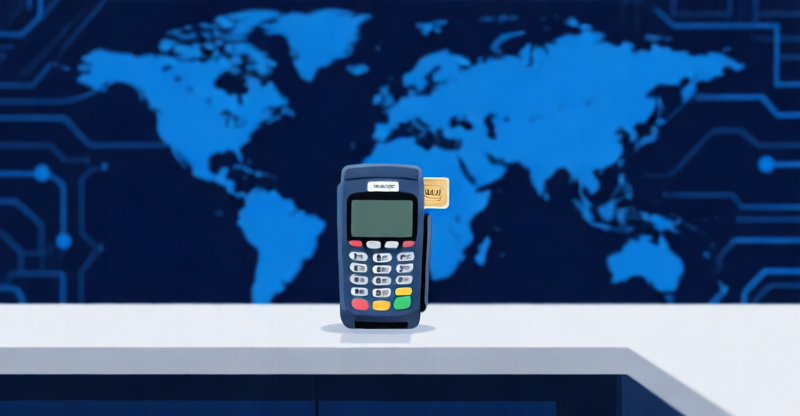
POS IoT connectivity procurement: global SIM/eSIM in 190+ countries, published data from €1.50/GB, SGP.32/SGP.31 profile switching; roaming SIM ≠ eSIM local profiles.
POS terminal compliance IoT connectivity is the technical and contractual bundle that links payment terminals to carrier networks through eUICC hardware, SGP.32/SGP.31 remote provisioning, and a connectivity management platform, giving each terminal a verifiable identity in 190+ countries. For a 10,000-device POS fleet, published data pricing starts at €1.50/GB (iot.cards [8]) — compliance reviews are won on profile control, not on the per-GB rate.
WHY IT MATTERS
SGP.32 changes the procurement baseline because it ties connectivity to hardware identity rather than to a carrier account. Every POS terminal maintains a verifiable, immutable identity tied to its eUICC, which eliminates SIM-swapping attacks, counterfeit devices entering the fleet, and impersonation risks [1] — risks Cavli describes as critical for compliance-heavy payment systems. SGP.32-compatible hardware supports emerging 5G IoT networks, while profile activation, operator switching, policy updates, and diagnostics run from a central dashboard [1]. Changing providers is possible without replacing the SIM card [7].
Procurement managers note that 'global roaming' SIM offers are not equivalent to eSIM local profiles. An eSIM can hold several profiles with different IMSIs and switch by country, coverage, or cost [8]. The coverage footprint is the same — 190+ countries — but operational profile control belongs to the buyer, not the roaming desk [8].
TYPICAL APPLICATIONS
Four deployment profiles dominate POS procurement. Each maps to a distinct buying route: catalog global IoT SIM, project-quoted eUICC eSIM, CMP platform, or regional catalog SIM.
Retail Chain Fleets: One Global SKU
If you operate 100–10,000 payment terminals, one global IoT SIM SKU is the standard procurement structure. Com4 reports the global SIM works across 190+ countries with a single SKU, cutting inventory complexity and keeping fleet behavior consistent, so hardware can be designed once and shipped anywhere [4]. Data is catalog-priced from €1.50/GB for POS traffic [8].
Terminal Manufacturers: In-Factory Provisioning
For manufacturers shipping thousands of units per month, field SIM activation is the bottleneck. In-factory profile provisioning (IFPP) embeds connectivity during manufacturing, and zero-touch onboarding assigns profiles based on device location or business rules [5]. eUICC hardware and profile engineering are quoted per project based on volume [8]; the per-GB data line stays on the catalog [8].
Mobile POS / SoftPOS: Constrained Resources
Resource-limited softPOS devices cannot run heavy eSIM clients. 1GLOBAL's answer is SGP.31 remote provisioning plus eSIM IoT Remote Management (eIM) of eSIM profiles for POS terminals with limited resources, delivered across 190+ countries and a 600+ carrier network [6]. Budget a project quote here, because eIM ties profile management to the device firmware.
Legacy 2G/3G Estate Refresh
Payment terminals still booting on 2G/3G can keep a single hardware design through migration: 1oT documents 2G, 3G, and 4G coverage in over 190 countries with 1,000+ networks and automatic selection of the best available network [7]. Over-the-air updates customize coverage or add providers without replacing the SIM card [7]. Data is catalog-priced; migration engineering is a project quote.
TECHNICAL SPECIFICATION / COMPARISON TABLE
Suppliers do not all mean the same thing by 'global SIM'. The table below maps procurement dimensions to the three offer types most RFPs weigh; the rows show what the reviewed sources actually commit to.
| Procurement dimension | Global roaming multi-IMSI SIM | eUICC eSIM (SGP.32 / SGP.31) | Single-country SIM |
|---|---|---|---|
| Coverage | 190+ countries [4][7] | 190+ countries; 600+ networks (1GLOBAL [6]), 750+ (iot.cards [8]), 1,000+ (1oT [7]) | 1 country |
| Profile switching | OTA update of IMSI list [4] | Remote profile download by country, coverage, or cost [8]; no SIM replacement [7] | Manual SIM swap |
| Identity audit | Home-carrier roaming terms | Verifiable immutable eUICC identity per terminal [1] | Local carrier contract |
| POS data price (published) | From €1.50/GB (POS) [8] | From €1.50/GB (POS); from €0.005/MB (low-consumption) [8] | Carrier rate card |
| Procurement model | Catalog (multi-IMSI) [4] | Catalog data + project quote for eUICC hardware/profiles [8] | Catalog or MNO contract |
| Compliance control | Home-carrier routing | Local IMSI per country + CMP audit trails [2][5] | Local by design |
Coverage row detail: 1GLOBAL documents 190+ countries and 600+ carrier networks [6]; iot.cards documents 190+ countries and 750+ networks for both eSIM and physical SIM [8]; 1oT documents 2G/3G/4G in 190+ countries with 1,000+ networks [7]. The spread is a vendor footprint difference; map it to the networks your payment processors depend on.
SELECTION NOTES
Use catalog pricing when three conditions hold: deployment stays within 1–3 countries; no mid-contract operator switching is required; and the compliance review accepts a single-carrier profile. The published pay-as-you-go rates apply directly — from €0.005/MB for low-data readers and from €1.50/GB for POS-class terminals [8].
Move to project quote when the fleet crosses 10 countries, profiles must terminate locally, or manufacturing uses in-factory provisioning. eUICC hardware and profiles are project-priced per volume [8]; CMP and API orchestration add a contract layer [5]. Put SGP.32 in the RFP when each terminal requires immutable identity [1]; request SGP.31 with eIM where POS devices have constrained resources [6].
COST MODEL / TCO
POS connectivity cost splits into four lines: hardware/eUICC, catalog data, CMP platform, and integration. Only the data line has published rates; the rest go through project quotes.
What does the data line cost?
iot.cards publishes two pay-as-you-go points: from €0.005/MB for low-consumption devices and from €1.50/GB for data-intensive deployments such as video surveillance and POS [8]. No lock-in is stated for these catalog rates [8].
10,000-Device Volume Scenario
Assume 10,000 terminals averaging 100 MB per month: usage is 1,000 GB/month, and at €1.50/GB that equals €1,500 per month, or €18,000 per year. A light fleet at 50 MB per device-month costs €9,000 per year; a traffic-heavy fleet at 500 MB costs €90,000 per year. Insert your own average-bytes-per-transaction and OTA update frequency to set the MB envelope before comparing quotes.
eUICC Hardware and Profile Management
Source documentation shows only that eUICC hardware and profile management are quoted per project based on volume [8]. Split this line from data in the budget and request a per-device profile price; treating it as a data surcharge hides the real cost.
Platform, API, and Maintenance
Abstraction platforms normalize APIs, enforce consistent policies, and provide cross-provider analytics — the operational pattern FloLive recommends for global deployments where no one CMP covers all countries and compliance regimes [5]. Platform vendors position audit trails and automated responses as 2026 compliance deliverables [2]. Platform price is a project quote; ask for RESTful M2M API access plus centrally managed monitoring and diagnostics [1] in the statement of work.
190+ Country Rollout and Avoided Cost
One global SIM line works across 190+ countries with one SKU, simplifying procurement and reducing inventory complexity [4]. Pre-activated SIMs from a single global provider remove delays caused by fragmented procurement across multiple carriers, manual activation requirements, and regional regulatory hurdles [4]. Paired with IFPP, profile embedding during manufacturing cuts time-to-market further [5].
Payback Driver
Because operator switching happens over-the-air, no SIM-card replacement is required [7], and the immutable eUICC identity stays in the audit trail [1]. Your cost per field SIM swap and per counterfeited terminal is the payback base; published catalog data rates between compliant offers are usually too close to decide on — the public anchor is €1.50/GB [8].
PROCUREMENT REALITY CHECK
Scenario: a 10,000-device POS rollout at 100 MB average per terminal per month has a data line of €18,000 per year at the published €1.50/GB rate [8]. Vendor selection logic needs two columns: catalog data price and project-quoted profile/CMP cost. Deployment teams report that comparing only the data column puts roaming-based contracts and eUICC contracts at parity. Procurement managers note that 'global roaming' SIM offers are not equivalent to eSIM local profiles — the roaming offer leaves terminals on the home carrier's IMSI, while an eUICC downloads local profiles in-country as needed [8]. SGP.32's verifiable, immutable per-terminal identity is the property that satisfies a compliance-heavy payment review [1].
CATALOG PRICING VS. PROJECT QUOTE
Catalog pricing is sufficient when deployment stays in 1–3 countries; no over-the-air operator switching is required; and your usage profile fits the published pay-as-you-go rates — from €0.005/MB for low-data readers, from €1.50/GB for POS [8]. Multi-IMSI global SIM cards also sell on catalog rates when coverage breadth is the only requirement [4].
A project quote is mandatory when terminals ship to 10+ countries; in-factory provisioning is planned [5]; devices require eIM (SGP.31) [6]; or the compliance review demands audit trails with API-level policy enforcement [2]. eUICC hardware and its profiles are project-priced per volume [8], and CMP platform contracts are quoted separately [5]. Measurable trigger: the moment the RFP names SGP.32 or SGP.31, move the profile-management line out of catalog pricing.
Published technical specifications for POS-grade IoT connectivity procurement
| Specification | Published Value | Procurement Impact |
|---|---|---|
| Remote provisioning | SGP.32 for IoT eSIM [1][5]; SGP.31 with eIM for constrained POS [6] | Determines whether zero-touch onboarding is possible at scale |
| eUICC identity | Verifiable, immutable identity per terminal [1] | Blocks SIM-swap and counterfeit-device risks in compliance audits |
| Coverage | 190+ countries; 600+ networks (1GLOBAL [6]); 750+ (iot.cards [8]); 1,000+ (1oT [7]) | Single-SKU global procurement |
| Published data pricing | From €1.50/GB for POS; from €0.005/MB for low-consumption devices [8] | POS data budget model per transaction volume |
| Profile capacity | Multiple profiles with different IMSIs; OTA switching [8] | Local-profile compliance option per country |
| CMP capability | API normalization, audit trails, automated responses [2][5] | Avoids carrier lock-in and produces audit evidence |
Procurement comparison: global roaming SIM vs. eUICC eSIM with local profiles vs. regional single-carrier SIM
| Dimension | A: Global Roaming SIM (multi-IMSI) | B: eUICC eSIM with Local Profile | When to Choose |
|---|---|---|---|
| Profile termination | Home-carrier IMSI; roaming agreements | Local IMSI profiles downloaded OTA [8] | B for regional compliance reviews |
| Operational control | OTA update of IMSI list [4] | Central dashboard; SGP.32 automation; eIM [1][6] | B for fleets above 1,000 devices |
| Coverage span | 190+ countries [4][7] | 190+ countries; 600–1,000+ networks by provider [6][7][8] | A or B at multi-country scale |
| Data price | From €1.50/GB (POS) [8] | From €1.50/GB (POS); €0.005/MB (sensors) [8] | Compare management cost, not just data price |
| Compliance evidence | Carrier roaming terms | Immutable eUICC identity; CMP audit trails [1][2] | B when audit trail is required |
Frequently Asked Questions
What is POS terminal compliance IoT connectivity, and which numbers matter?
It is the combination of eUICC hardware, SGP.32/SGP.31 remote provisioning, and a connectivity management platform that gives each payment terminal a verifiable identity in 190+ countries. The published data anchor is €1.50/GB for POS-class usage and €0.005/MB for low-consumption devices (iot.cards [8]).
How much does a global IoT SIM data plan cost for a 10,000-terminal POS fleet?
At the published rate of €1.50/GB, 10,000 terminals averaging 100 MB per month generate 1,000 GB/month, or €18,000 per year. A light fleet at 50 MB per device-month costs €9,000 per year; a heavy fleet at 500 MB costs €90,000 per year. eUICC hardware and profiles are quoted per project based on volume (iot.cards [8]).
eSIM vs physical SIM for POS terminals: which should procurement select?
Coverage is identical — 190+ countries and 750+ networks for both form factors in iot.cards' documentation. The difference is operational: eSIM supports profile management and over-the-air operator switching, while a physical SIM requires a swap. Choose eSIM when the RFP requires remote profile control or SGP.32 identity features.
Why do procurement managers reject 'global roaming' SIMs for POS compliance?
Procurement managers note that 'global roaming' SIM offers are not equivalent to eSIM local profiles. A roaming SIM keeps terminals on a home-carrier IMSI, while an eUICC can download local profiles in-country by coverage or cost. For payment compliance, the verifiable immutable eUICC identity under SGP.32 is the differentiator.
Should the RFP specify SGP.31 or SGP.32 for POS connectivity?
Both appear in real POS eSIM offers: Cavli Wireless and FloLive document SGP.32 for IoT-scale automation and zero-touch onboarding, while 1GLOBAL uses SGP.31 remote provisioning with eSIM IoT Remote Management (eIM) for POS devices with limited resources. Ask suppliers which SGP implementation they support and how it maps to your device firmware.
References
- SGP.32 eSIM for POS Solutions | Zero-Touch IoT Connectivity
- IoT SIM Security Features: The 2026 Guide to Protecting Global Deployments
- Empowering POS Systems with Seamless Global Connectivity and Intelligent IoT Networks | NuvoLinQ
- Managing Global IoT SIM Cards in 2026
- Today's IoT Connectivity Management Platform: The Difference
- POS IoT Connectivity for Retail | IoT eSIM for Always-On Uptime
- Global Connectivity For Payment Terminals
- Global IoT eSIM (eUICC): SGP.32, Pricing, Multi-Carrier