Public Kiosk Connectivity Procurement: $1/yr to $50/mo per Device — Global IoT SIM, eSIM, and CMP Decisions
· 6 min read · Case Studies
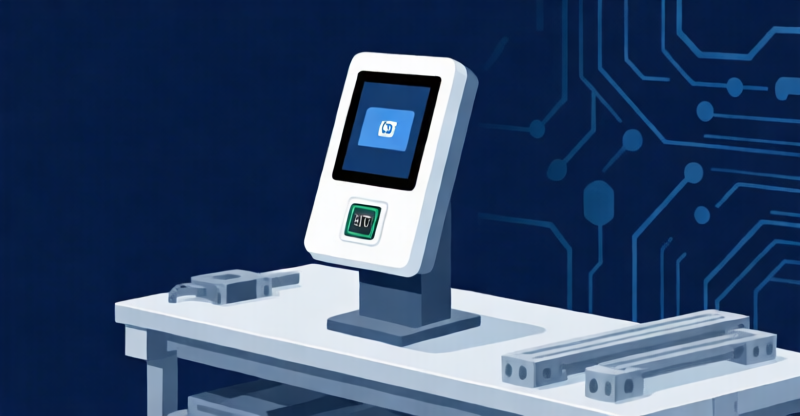
Public kiosk connectivity runs $1/yr to $50/mo per device. Global IoT SIM/eSIM/CMP choices decide catalog vs project quote.
Public kiosk connectivity is the cellular link that carries payment, monitoring, and health-report traffic from interactive terminals to a back-end platform. For a 1,000-kiosk rollout, the public-network connectivity cost spans $1 per year to $50 per month per connection [5] — a 600x spread that makes SIM and CMP selection a budget decision, not a technical footnote.
Buy it through a global IoT SIM or eSIM SKU managed on a CMP, and you are buying a managed service contract. Buy it as a plain M2M SIM, and you are buying per-country inventory. The trigger is simple: in a 3-country rollout, if any country needs CMP, eSIM, or multi-country control, move from catalog pricing to a project quote [6][8].
WHY IT MATTERS
The procurement boundary changed because connectivity can now be embedded before deployment. Emnify's factory-first Instant Connectivity model, unveiled at CES 2026, uses Bootstrap Connectivity and a single global eSIM SKU to eliminate SIM logistics, manual provisioning, and first-boot activation failures [1]. For a kiosk manufacturer shipping across three countries, that removes weeks of SKU planning and fulfillment.
At the same time, the CMP market is projected to grow from $5.8B in 2026 to $32.0B by 2033 [1]. That growth reflects the operational need: managing thousands of devices across networks requires activation, usage monitoring, network policy, and API automation [3]. The old model of buying a SIM per country and reconciling manually no longer scales.
TYPICAL APPLICATIONS
Application 1: Retail self-checkout and payment kiosks
Retail kiosks combine payment, remote monitoring, and health reporting [6]. The operational requirement is stable uptime and auditable control [6]. A CMP gives per-device usage data and billing/reporting [2], so a 500-unit rollout can allocate connectivity costs per store instead of treating a carrier invoice as a single lump.
Application 2: Transport and ticketing kiosks
A single dropped connection can paralyze revenue [7]. For ticketing terminals, define usage baselines, implement data pooling, and set multi-stage thresholds at 75%, 90%, and 100% of the data cap [7]. This is where CMP policy APIs [3] turn connectivity from a monthly bill into a controllable operating metric.
Application 3: Hospitality and wayfinding kiosks
The kiosk market is projected to reach $31.32B by 2026 [7], and many of those units sit in hotels and malls where a failed check-in terminal creates visible customer friction. eSIM with Bootstrap Connectivity at manufacturing [1] means the unit connects when powered on, and the CMP dashboard [4] gives the operator a single view of SIMs that previously required local carrier relationships.
TECHNICAL SPECIFICATION / COMPARISON TABLE
The table below maps 5 procurement-relevant dimensions to the specification that changes your buy decision.
| Dimension | Specification | Procurement impact |
|---|---|---|
| SIM form factor | Physical SIM, eSIM/eUICC, multi-IMSI | eSIM reduces per-country SKU count [1] |
| Provisioning model | Bootstrap Connectivity at manufacturing | Eliminates manual provisioning and first-boot failures [1] |
| CMP billing granularity | Per-device, per-SIM, per-customer usage data [2] | Enables cost allocation and overage control |
| API automation | Activate SIMs, monitor usage, manage policies via APIs [3] | Scales operations without adding headcount |
| Connectivity price range | $1/year to $50/month per connection [5] | Drives catalog vs project-quote decision [6][8] |
SELECTION NOTES
Choose a catalog SIM when the deployment is 1 country, 1 carrier, no CMP requirement, and a known traffic profile [8]. A 50-kiosk pilot in one city with a fixed data plan fits that path: you buy a country-specific IoT SIM, activate it through the provider portal, and leave the CMP out of the contract.
Move to a project quote when any of these triggers appear: multi-country control (2+ countries), eSIM management, CMP operations, or volume delivery [6][8]. The measurable trigger is whether you need to switch networks or manage connectivity policies centrally [3]. If yes, catalog SKUs are the wrong procurement vehicle — the quote should include CMP setup, API integration, and local regulatory reconciliation.
COST MODEL / TCO
Connectivity Cost per Device
Public network connectivity ranges from $1 per year to $50 per month per connection, depending on location, bandwidth, and volume [5]. At the midpoint of that publicly available range — roughly $25/month — a 1,000-kiosk fleet costs $300,000/year in connectivity alone.
Platform Cost
CMP fees are not quoted separately in the cited sources, but the market projection — $32B by 2033 [1] — tells you platform cost is becoming a line item. Granular per-device billing and reporting [2] lets procurement managers track cost drivers and optimize usage across the fleet.
Engineering and Reconciliation Cost
Procurement managers note that the biggest hidden cost in Jordanian deployments is the 3–8 weeks of engineering time spent reconciling the TRC registration list with the local carrier's billing system. Assuming a loaded rate of $75/hour, that is $12,000–$24,000 of engineering time per country before a single kiosk transaction runs.
Procurement Reality Check
A Jordanian kiosk deployment with global IoT SIMs looks fine on paper until the local regulator's registration list and the carrier's billing system disagree. The 3–8 weeks of reconciliation can extend the project by 25–67% on a 12-week plan. How do you buy around it? Use a CMP with per-device usage and billing data [2] so the engineering team isn't building manual reconciliation reports. If the SIM vendor cannot expose that data through an API (RESTful M2M style) [3], move the requirement into the project quote.
From the Field
Deployment teams report that the 3–8 weeks of TRC-to-billing reconciliation is rarely in the project plan, so it lands as post-launch engineering overhead. Procurement managers note that this cost — not the SIM price — drives the make-or-break decision between catalog pricing and a project quote [6].
Payback
If a CMP's per-device billing [2] avoids four weeks of reconciliation labor per country, the payback equals the loaded hourly rate times 160 hours. At $75/hour, that is $12,000 per country saved — enough to justify a project quote even when the catalog SIM plan appears cheaper upfront.
CATALOG PRICING VS PROJECT QUOTE
Catalog pricing is enough when the rollout is 1 country, 1 carrier, no eSIM profile management, and no CMP requirement [8]. You can accept a single-country SIM SKU, standard activation, and usage reports.
Go to project quote when any of these triggers exist: multi-country control (2+ countries), eSIM management, CMP operations, volume delivery [6][8], or regulatory reconciliation like the Jordanian TRC billing mismatch. The quote should include the engineering hours required to reconcile carrier billing with registration data, or the API integration to automate it [2][3].
Procurement-relevant kiosk connectivity specifications
| Dimension | Specification | Procurement Impact |
|---|---|---|
| SIM form factor | Physical SIM, eSIM/eUICC, multi-IMSI | eSIM reduces per-country SKU count [1] |
| Provisioning model | Bootstrap Connectivity at manufacturing | Eliminates manual provisioning and first-boot failures [1] |
| CMP billing granularity | Per-device, per-SIM, per-customer usage data [2] | Enables cost allocation and overage control |
| API automation | Activate SIMs, monitor usage, manage policies via APIs [3] | Scales operations without adding headcount |
| Connectivity price range | $1/year to $50/month per connection [5] | Drives catalog vs project-quote decision [6][8] |
Physical SIM vs eSIM for kiosk rollouts
| Dimension | Physical SIM | eSIM | When to Choose |
|---|---|---|---|
| Provisioning lead time | Weeks (SIM logistics) | At manufacturing via Bootstrap Connectivity [1] | eSIM for multi-country |
| SKU complexity | Per-country SKUs | Single global SKU [1] | eSIM for large fleets |
| CMP control | Supported via APIs [3] | Supported via APIs [3] | Either, with CMP |
| Pricing structure | Catalog possible | Project quote when multi-country [6][8] | Quote when 2+ countries |
Frequently Asked Questions
What is the best IoT connectivity for kiosks?
For public kiosks, the procurement path is a global IoT SIM or eSIM paired with a CMP. The right choice depends on your country list and traffic profile; if the rollout needs CMP, eSIM, or multi-country control, move from catalog pricing to a project quote [6][8].
How much does IoT connectivity cost per device in 2026?
Public network connectivity ranges from $1 per year to $50 per month per connection, depending on location, bandwidth, and volume [5]. For a 1,000-kiosk fleet, that is a $1,000/year to $600,000/year swing.
What is the difference between IoT platform pricing and connectivity pricing?
Connectivity pricing is the fee paid to a network operator — $1/year to $50/month per connection [5]. Platform pricing covers the CMP that manages SIMs, usage, and billing; the CMP market is projected at $32B by 2033 [1], and CMPs collect usage data per device, SIM, or customer [2].
Can I manage IoT and enterprise mobile connectivity on one platform?
The cited CMP sources describe IoT-focused features: SIM activation, usage monitoring, network policy, and API automation [3]. Whether one platform also manages enterprise mobile lines depends on the vendor's product scope; the referenced sources do not claim a unified enterprise mobility + IoT platform.
Is eSIM worth it for IoT deployments?
For kiosk rollouts, eSIM embedded at manufacturing can eliminate SIM logistics, manual provisioning, and SKU fragmentation [1]. If your rollout needs multi-country control, the trigger is a project quote rather than catalog pricing [6].
How do I reduce IoT roaming costs?
Use data pooling, define usage baselines, and set multi-stage thresholds at 75%, 90%, and 100% of the data cap [7]. Complement that with CMP billing/reporting to track usage per device and optimize across carriers [2].
References
- IoT Connectivity Management Platform Market
- Connectivity Management Platform: 6 Key Features & CMP for IoT
- IoT Connectivity Management | Secure & Scalable Networks
- IoT connectivity platforms: An easy guide to manage SIMs
- IoT Connectivity
- Kiosk SIM | Global IoT SIM Device Connectivity Guide | Quanqiu IoT
- IoT Connectivity for Kiosks: 2026 Strategic Guide
- Thailand IoT SIM Card for Business | Best M2M Carrier Path | Quanqiu IoT